What is Beauty ?
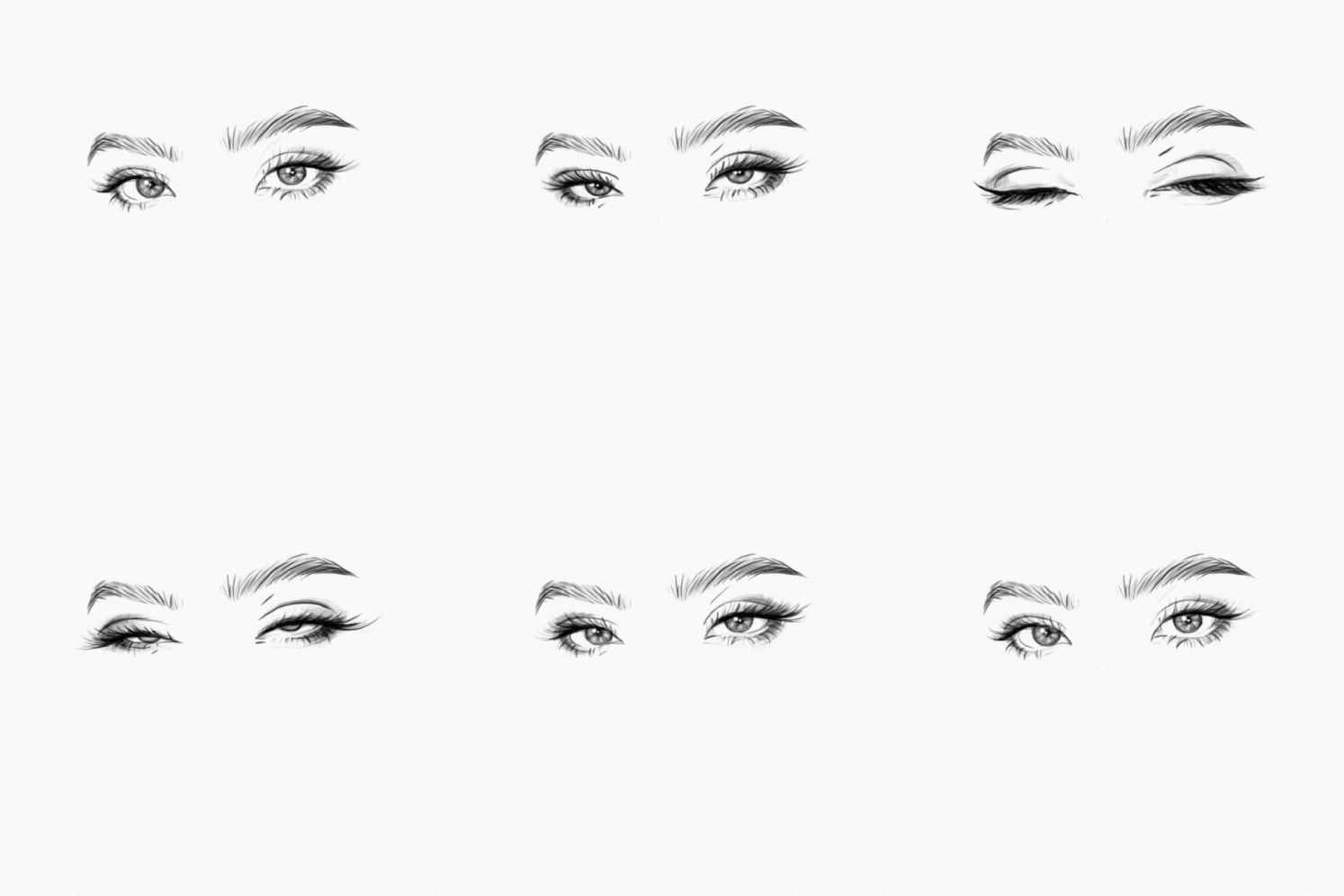
I don’t think that there’s a clear answer to this question. People have been deliberating over the nature of beauty for centuries, and I partly know this because I had to take a whole course on it. I was originally going to take a trip down memory lane, crack open my old textbook, and reiterate what other philosophers have said about the subject. But then I thought it would probably be more fun to come up with a thesis of my own instead. So I grabbed the nearest cigar (just kidding), found the nearest rock, placed my fist on my chin, and started thinking. Here are some thoughts:

Intro
The human eye is an intricate system that has inspired much of the design and technology of modern day cameras and telescopes. I believe I was in grade 9 when we did a whole module on how the human eye functioned, and we ended this exploration with a dissection of a cows’ eye. I remember it being messier than the diagrams in our textbooks, and I can still smell the scent of the grey, and brown substance that escaped its cavity at the pressure of my scalpel. I quickly realized that there was no way I was going to become a surgeon, and I’ve never looked back. Anyway, despite my dream of becoming Meredith Grey seeing its end, I still remained fascinated with what I had learned about the human eye. This small organ works with light to allow light perception, color vision, and depth perception. In other words, sight is “light bouncing off of stuff” (CrashCourse). I’m not going to go into a full scientific breakdown of how it all works, as I want to get to the meat of our main subject, but here is a little video for you science lovers and visual learners:
Objectively subjective
Objective notions such as the human eye can help us understand more subjective terms, like that of beauty - and If you’re like me, understanding these concepts scientifically may help you translate them metaphorically. For the remainder of this piece, I will be using the human eye as a metaphor of sorts to lead us into my main thesis of what I believe “beauty” is. But first, a few fun facts about the human eye mentioned in the video above:
Nearly 70% of all the sensory receptors in your whole body are in the eyes.
In order for you to see, perceive and recognize something…. Nearly half of your entire cerebral cortex has to get involved.
In summary, the eye is composed of the cornea (the outer shell that protects the eye and lets light in), the iris (the pigmented part of the eye which is essentially made up of muscles which contract and expand the pupil), the pupil (the opening of the iris that allows for light to enter the eye), and last but not least, the retina (holds millions of photoreceptors which convert light energy into the electrical signals which your brain will receive).
The human eye can only see certain colours and shapes.
Okay, so I'm sure you see the point, the human eye is complex and is made up of a lot of different parts which work synchronistically to allow us to see all that there is in the world. Or does it? Well turns out, as extraordinary as the human eye is, it actually only allows us to see within a limited scope. The video alluded to this when it said that “the human eye can only see certain colours and shapes”. That's because it is limited to the cones, and rods that are found in its interior. This is why we utilize things like microscopes to see what our eyes are unable to pick up naturally. Microscopes expand our scope and horizons, and allow us to see the unseen. Now, you may be asking yourself, what does beauty have to do with any of this? Well, I’m sure we have all heard of the famous proverb that goes something along the lines of:
“Beauty is in the eye of the beholder”
If you haven’t heard of it before, what it is pretty much saying is that beauty is not something that can be viewed objectively, but instead can only be interpreted subjectively from individual to individual. Ideas such as these have been debated for centuries and have developed into their own philosophy known as philosophical aesthetics. As many of the philosophers that have come before me, I want to attempt to push back on this idea and suggest something else instead.
Thesis
Beauty is not in the eye of the beholder, but limited to it. In other words, Beauty is limited to the eye of the beholder. In this sense, beauty functions similarly to the human eye, in that it is limited to its ability to process the light that shines through it. On the flip side, beauty is also limited to one's prior perception of beauty. What do I mean by this? Let’s do a little exercise- what do you see in this picture?

This image has often been used to drive home many points. The point I am trying to make today is how perceptions illustrate our realities. Some of you might see the side profile of a young woman, while others see the image of a frail old lady, some might see both. None of these answers are wrong, because depending on how one looks at it, all of those perceptions are valid. This brings us back to my main thesis; not only is beauty limited to the eye of the beholder, it is also limited to their perception. Simply put:
That’s just my preference
Perceptions are informed by bias, and together they inform our preferences. These preferences directly affect what we see as beauty. Here me loud and clear, it is okay to have preferences. In fact we all have programmed preferences, however these preferences aren’t fully out of our control. With this idea in mind, it is important that everyone examines where these preferences come from, as some of them might be hindering us from experiencing the wide scope of beauty that exists in the world. For example, I don’t like shrimp. My dislike of this popular seafood began at a young age. It is a long story so i’m going to shorten it. I was in elementary school, and I had recently learned about where babies came from - I was a bit traumatised to say the least. Anyways, during the same time we had also visited the aquarium on a school field trip, and I had seen and learned about seahorses for the first time. The most important fact that I took from that day is that, male seahorses are the ones who get pregnant & give birth (Whittington, 2018). This was revolutionary for little Keyla, and I specifically remember thinking how lucky female seahorses were for not having to experience childbirth. Keyla, what does this have to do with beauty, or shrimp? I’m getting there I promise, thank you for making it this far. What started that day was an unhealthy connection to seahorses. Most little girls wanted to be a mermaid, and I was like nah… I wanna be a seahorse. Since then I prefer not to eat shrimp, only because they reminded me of seahorse tails. Yup, that’s it. I’ve had shrimp before, I actually like the taste of it, I just can’t get the seahorse image out of my head. My perception of shrimp literally altered my choices despite my taste. My preference is not to eat shrimp, but I can trace back that preference to a memory, and understand what caused it.
One more thing about shrimp
Speaking of shrimp, have you ever heard of the mantis shrimp? “As compared to humans' measly three color-receptive cones, the mantis shrimp has 16 color-receptive cones, can detect ten times more color than a human, and probably sees more colors than any other animal on the planet” (Levine, 2017). What is most fascinating about this fact, is that there are colours and hues out there that human beings can’t see. However, “although the crustaceans have many more types of light-detecting cells than humans, their ability to discriminate between colours is limited” (Morrison, 2014). Looks like the mantis shrimp, and humans might have something in common... How much beauty exists in our environment that we don’t see due to our limited ability to discriminate between biases and authentic beauty ?
“Beauty is a horizon”
Antithesis, Synthesis & Disclaimer
I want to take a moment to recognise that there exist a diverse range of functions when it comes to sight. Although the metaphor of the human eye used in this piece mostly describes one experience of how the eye can function, I need to stress that all experiences of sight can give us a deeper understanding and appreciation for beauty. The emphasis of this thesis is less about sight, and more about our perceptions. The ways in which we can see beauty is endless … But wait, if the perception of beauty is endless, then doesn’t that mean that anything can be beautiful? My answer to this is simply NO. Even in its natural meaning, a horizon functions within limits, but it is up to us to decide how far those limits can stretch. If anything can be beautiful, as can be deduced from the traditional claim that “beauty is in the eye of the beholder”, then we risk encountering several moral dilemmas. Simply put, there have been a lot of historical & present ideas about beauty that lack ethical consideration.
Here is an interesting documentary that touches on the subject:
What I am trying to suggest instead, is that we expand our horizon in order to uncover places where beauty was originally hidden from our scope. However, it is also equally as important that there comes a point where heaven & earth meet (i.e. our preferences & morality) to set necessary boundaries.
Job said it best:
“ He marks out the horizon on the face of the waters for a boundary between light and darkness.” Job 26:10
Conclusion
Another illustration I can use to expand on this last point is written in the stars. When you look up at the night sky, the stars you see are but a small number of the stars that actually exist. Some of the most beautiful and brightest stars are not visible due to a number of factors, one of them being the clarity of the sky. Again, there is so much beauty out there, but our perception of it can be limited due to our lack of clarity, and visual scope. Just like the eyes, the filters in which we see the world influence our perception of things, more importantly our perception of beauty. Another cool thing about the night sky is that, technically when you’re looking up at night, you are actually looking into the past (Brown, 2018). What you see, has already been done, and is continuously changing. Thunder works in similar ways, “there’s a flash of lightning, and then seconds pass until we hear the rumble of distant thunder. We hear the past” (Brown, 2018). Don’t our societal beauty standard function in similar ways? Everything has “already been done”, and what is deemed as beautiful seems to change so quickly that it’s almost impossible to keep up with. As soon as one trend comes out, a new one is already in the works. There is nothing inherently wrong with this, however if we base our ideas of beauty on this rocky foundation, we risk not being able to see clearly. Beauty is less of a what, and more of a how much ?! Let’s change our thinking about what is beauty- to how much beauty can I choose to see in the world, in a given situation, and more importantly in myself. In conclusion, beauty is a horizon, so don’t limit yours.
A little encouragement
For those of us who don’t feel represented by the world's idea of beauty, take heart, because even the brightest stars and colours can’t be detected by the common eye. Keep on shining bright. The scope of your beauty is endless.

What's your name, and WHO ARE YOU BECOMING ?
References
Boundless. “Boundless Physics.” Lumen, courses.lumenlearning.com/boundless-physics/chapter/the-human-eye/.
Brown Associate professor in astronomy, Michael J. I. “When You Look up, How Far Back in Time Do You See?” The Conversation, 16 Apr. 2020, theconversation.com/when-you-look-up-how-far-back-in-time-do-you-see-101176.
Levine, Jennifer. “5 Things You Didn't Know about How Animals See Color.” Home, 2017, crosstalk.cell.com/blog/5-things-you-didnt-know-about-how-animals-see-color.
Morrison, Jessica. “Mantis Shrimp's Super Colour Vision Debunked.” Nature News, Nature Publishing Group, 2014, www.nature.com/news/mantis-shrimp-s-super-colour-vision-debunked-1.14578.
“Another cool thing about the night sky is that, technically when you’re looking up at night, you are actually looking into the past (Brown, 2018). What you see, has already been done, and is continuously changing.” Amazing! Reminds me of this Bible passage from Ecclesiastes 1:8-9 (NIV): “All things are wearisome, more than one can say. The eye never has enough of seeing, nor the ear its fill of hearing. What has been will be again, what has been done will be done again; there is nothing new under the sun.”
ReplyDelete- Nathalie💗